At some point I had to sit down and get really honest with myself about how small I had become.
Not physically but in every other way that matters. My opinions had gotten quieter. My needs had become something I apologised for before I even voiced them. My personality, the loud, opinionated, occasionally too-much parts of it, had been carefully edited down to a version that felt safer. More acceptable. Less likely to cause friction.
I didn’t do it all at once. That’s the thing nobody tells you. You don’t shrink in one dramatic moment. You shrink in a thousand tiny ones, each of which felt completely reasonable at the time.
***Please note that this site uses affiliate links if you would like to read the legal stuff you can find it here
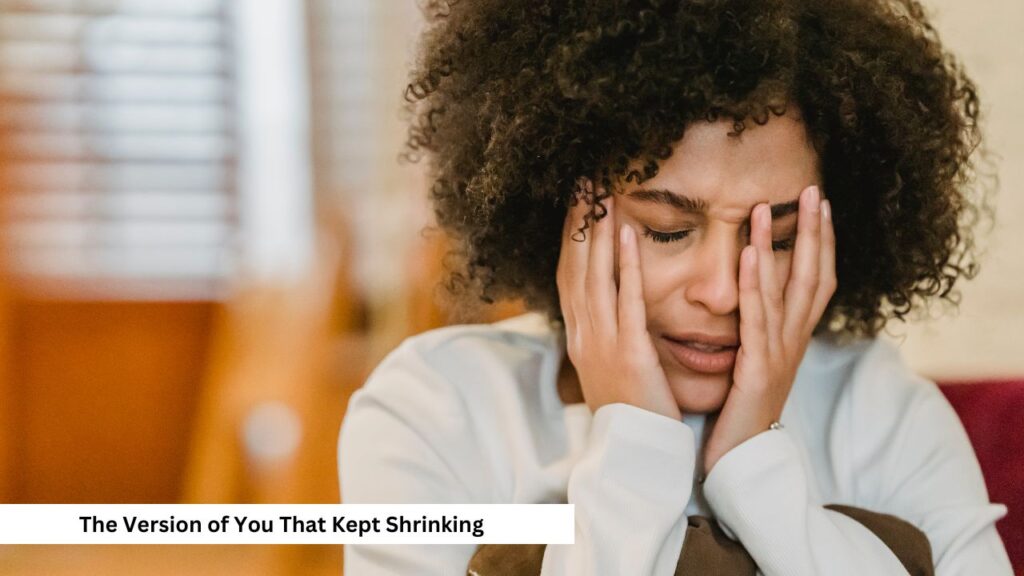
It Starts So Small You Barely Notice
The first time you don’t say something because you don’t want to rock the boat, it feels like maturity. Like you’re choosing your battles. The first time you dial back your excitement about something because it doesn’t land the way you hoped, it feels like reading the room. The first time you change your mind about something, not because you actually changed your mind, but because disagreeing felt like too much work, it feels like compromise.
None of those individual moments feel like a crisis. Not one of them sounds the alarm. They just quietly stack up, one on top of the other, until one day you’re in the middle of a conversation and you realise you have no idea what you actually think anymore because you’ve been filtering everything through someone else’s preferences for so long that your own voice got buried under the noise.
That’s when you know. Something got lost somewhere along the way.
The Reasons We Do It Run Deep
I want to be clear that shrinking is not a character flaw. It’s not weakness. It’s not something to be ashamed of. In a lot of cases it’s a survival strategy that was completely logical given where it came from.
Some of us grew up in homes where being too much had consequences. Where a strong opinion got shut down fast. Where taking up too much space, emotionally, physically, verbally, wasn’t safe. So we learned to make ourselves manageable. Palatable. Easy.
Some of us learned it from relationships where expressing ourselves created conflict, withdrawal, or punishment. Where the person we loved made it quietly clear, over and over, that the easier version of us was the preferred one.
Some of us absorbed it from the world in general, the message that women who are too loud, too direct, too confident, too opinionated are difficult. Intimidating. Too much.
So we self-edited before anyone else could do it for us.
The reasons are different. The result looks exactly the same.
What It Actually Costs You
Here’s what I’ve noticed, and experienced, about long-term shrinking. It doesn’t just affect your relationships. It seeps into everything that you do.
You start second-guessing yourself in places that have nothing to do with the person you’ve been shrinking for. Your confidence in your own judgment quietly erodes because you’ve been overriding it for so long. You feel vaguely resentful in a way that doesn’t have one clear address. You feel tired in a bone-deep way that sleep doesn’t fix. I rememeber a period of time when I was married where I kepton saying that I was tired. It wasn’t sleep tired. It was a kind of exhaustion that I had never experiened before.
Performing a smaller version of yourself is exhausting. It requires constant monitoring. You’re always slightly on alert, checking whether you’re taking up too much space, whether your reaction was too big, whether you should have kept that thought to yourself.
Living like that over months and years costs something significant. It costs your sense of self. Your trust in your own instincts. Your ability to just be in a room as yourself without running an internal audit of whether you’re too much.

The Sneaky Thing About Shrinking Is That It Starts to Feel Normal
This is the part that catches people off guard. After a while, the edited version of yourself starts to feel like just who you are.
You forget that you used to have stronger opinions. You forget that you used to take up more space. You forget that the current version of you, quieter, more careful, perpetually adjusting, is not your default. It’s an adaptation.
Somewhere along the line I had learned to present my opinions as questions to soften everything. To agree just a beat too quickly. To make my certainty look like uncertainty so it was easier to swallow.
That was the moment I started paying attention.
So How Do You Actually Stop
Slowly. Imperfectly. In small moments that feel uncomfortable at first and then gradually feel more like coming home.
You start noticing the moments when you’re about to shrink. The thought you’re getting ready to swallow. The opinion you’re softening before it even leaves your mouth. You don’t have to fix it immediately — just noticing it is the beginning.
Then you start practising saying the thing anyway. Not aggressively. Not as a statement of war. Just as the honest version of what you think. In low-stakes situations first with people who are safe. You rebuild the habit of taking up space by taking up space, one small, deliberate moment at a time.
You also start paying attention to who around you requires your shrinking because some relationships can hold the full version of you and some genuinely cannot.
The ones that can’t, where showing up as yourself consistently creates friction, withdrawal, or punishment, that information matters. A relationship that only works when you’re smaller than you are is not a relationship that actually works.
You Are Not Too Much
I want to say this directly because I think a lot of women who have spent time shrinking have internalised the opposite message.
You are not too loud. You are not too opinionated. You are not too emotional, too intense, too direct, or too anything. You are a person with a full inner world, with thoughts and feelings and preferences and a point of view that is entirely your own.
The right people, the right partner, the right friends, the right spaces, will not require you to turn any of that down. They will not feel threatened by your confidence or exhausted by your realness or inconvenienced by your needs. They will just let you be there, as you are, without the constant performance of making yourself fit.
That is not too much to ask for. It is actually the minimum.
Final Thoughts on The Version of You That Kept Shrinking
The version of you that kept shrinking to fit, she wasn’t weak. She was doing what she’d been taught to do, what felt safest, what kept the peace. She was trying. She deserves grace, not judgment but she also deserves to come home to herself.
Not to a louder, more aggressive version of who she is, just the real version of her one. The unedited one. The one who has opinions and holds them. Who takes up space without apologising for it. Who knows that the right people will not need her to be smaller to feel comfortable around her.
That version of you hasn’t gone anywhere. She’s been waiting, quietly, for you to stop adjusting long enough to remember she was there.
Related posts: