There’s a version of losing yourself that’s dramatic and obvious. You look up one day and barely recognise your life.
Your friends are gone. Your interests have evaporated. You dress differently, talk differently, want different things, or rather, you’ve stopped being sure what you want at all because somewhere along the way you got so focused on what he wanted that yours stopped mattering.
There’s another version that’s much quieter. Much more gradual. The kind that happens in such small increments that you don’t notice until you’re already deep in it.
One small adjustment here, one swallowed opinion there, one thing you stopped doing because it was easier than explaining why it mattered to you.
That second version?
That’s the one I want to talk about because I think it’s far more common than most people realise, and far easier to miss until the damage is already done.
***Please note that this site uses affiliate links if you would like to read the legal stuff you can find it here
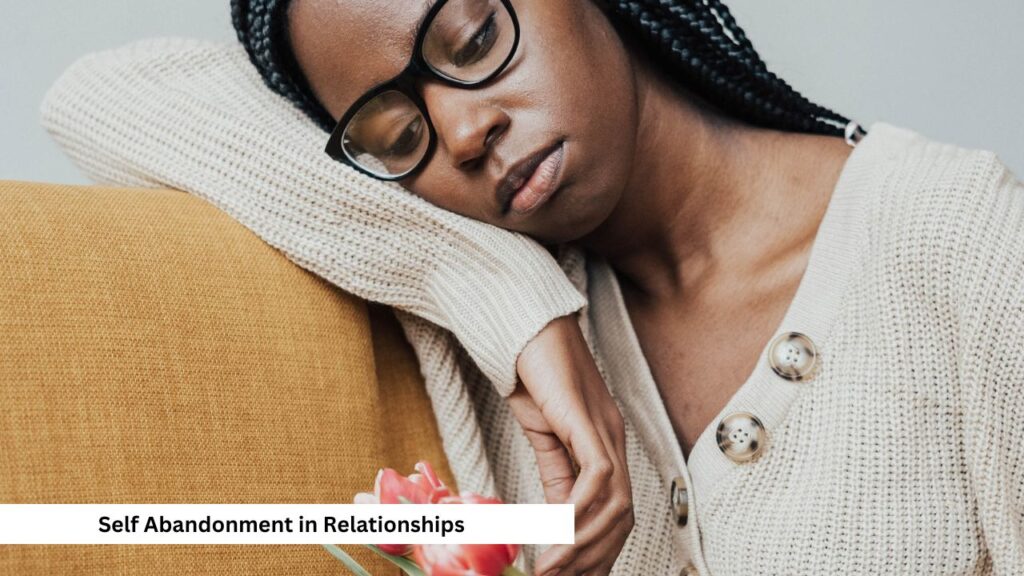
What Self Abandonment Actually Is
Self abandonment in a relationship is what happens when you consistently prioritise someone else’s needs, comfort, or emotional state over your own, to the point where your own needs stop feeling like they count.
It’s not the same as compromise. Compromise is two people adjusting.
Self abandonment is one person doing all the adjusting while quietly pretending everything is fine.
It’s saying yes when you mean no. It’s letting things slide that you said you wouldn’t let slide. It’s shrinking your feelings down to a size that won’t inconvenience anyone, including yourself.
Over time, it stops being a conscious choice. It becomes automatic. You stop knowing what you actually think, want, or feel independent of him. You’ve been adapting for so long that your own baseline got lost somewhere in the process.
The Sneaky Ways It Starts
Nobody sits down and decides to abandon themselves. It creeps in through choices that each feels small and reasonable in the moment.
You don’t bring up something that bothered you because you don’t want to start a fight. You cancel plans with your friend because he seems off that day, and you want to be available. You stop mentioning your goals as much because they don’t seem to interest him, and it’s easier than navigating that. You laugh at something that wasn’t funny to you. You agree with something you actually disagree with. You apologise for things that weren’t your fault because keeping the peace feels more important than being honest.
None of those things sound catastrophic on their own, but the pattern of them repeated across weeks and months and years is how a person disappears inside a relationship while technically still being present in it.
How You Know It’s Happening To You
Your opinions have started to mirror his more than feels coincidental. Not because you genuinely came around to his way of thinking, but because expressing a different view stopped feeling worth the friction.
You feel anxious about things you used to do freely, spending time with certain people, making your own decisions, and taking up space in the relationship.
You don’t know what you enjoy anymore. What you’d do if left to your own devices. What you’d choose if his preferences weren’t part of the equation.
You’ve started to feel resentful, that low, simmering kind that doesn’t have one clear source but seems to colour everything.
Resentment is almost always a sign that something went unaddressed for too long. It’s the emotional receipt for needs that were presented and then quietly set aside.
You feel like you’ve lost something, but you can’t quite name what. It’s more of a vague, persistent flatness. A sense that you used to be more, more vibrant, more sure of yourself, and more present in your own life.

Why We Do It: Because There Are Reasons
Self-abandonment doesn’t happen in a vacuum. There are reasons it develops, and most of them go back further than the current relationship.
If you grew up in an environment where your feelings were regularly minimised or dismissed, you learned early that expressing them wasn’t safe or worthwhile.
If love in your house was conditional based on being good, being easy, not being too much, you probably learned to perform whatever version of yourself that kept things smooth.
Some of us were taught so thoroughly that taking care of others was virtuous and taking care of ourselves was selfish that we internalised it as fact.
We became experts at reading other people’s needs and amateurs at identifying our own.
Then we walk into relationships carrying all of that. The relationship didn’t create the pattern, it just activated it.
What It Does To You Over Time
The longer self-abandonment goes on, the more disconnected you become from yourself. Your sense of identity becomes entangled with the relationship to the point where you’re not sure who you are outside of it.
Your confidence quietly erodes because a person who consistently overrides their own instincts stops trusting those instincts. The resentment builds. The emptiness deepens.
It also affects the relationship itself because you’re not actually in it as yourself, you’re in it as the version of yourself you edited down to fit. Which means the connection isn’t fully real. It’s built on a version of you that required constant maintenance to sustain.
That is exhausting in a way that’s hard to explain. Being loved for a curated version of yourself brings its own particular loneliness.
How You Start Coming Back To Yourself
The first step is the most uncomfortable one. Getting honest about the fact that it’s happening, not blaming, not catastrophising, just looking clearly at where you’ve been consistently choosing someone else’s comfort over your own truth.
Start noticing the moments when you silence yourself. Not to immediately fix them, just to notice. Awareness before action.
Start doing small things that are just for you. Not as a statement, not as rebellion, just as a gentle act of remembering that you exist independently of this relationship. A hobby. A friendship you let go quietly. A preference you stopped voicing.
Practice saying what you actually think in low-stakes situations. Work your way up. Rebuilding the habit of honesty with yourself takes time when you’ve been suppressing it.
If the relationship can’t hold the real you, if being yourself consistently creates conflict or punishment, that is information, important information.
A relationship that requires your self abandonment to survive is not a relationship that is actually working.
Final Thoughts on Self Abandonment In Relationships
Losing yourself in a relationship is one of the quietest forms of heartbreak because it happens without a single dramatic event. Just a slow drift away from who you were, so gradual that by the time you notice it, you’ve been gone for a while.
This is what I know to be true, you are still in there. The parts of you that got quiet didn’t disappear. They just got pushed to the back while you were busy managing everything else. They’re still there, waiting to be let back out.
Coming back to yourself is not about leaving necessarily, it’s about deciding that you matter enough to be present in your own life. That your feelings are worth expressing. That your needs are worth meeting. That the full, uncurated, sometimes inconvenient version of you deserves to be in the room as well.
I know because I’ve been there.
Related posts:
Why you overthink in relationships
8 Things healed women do differently in relationships
How to trust again in a relationship without losing yourself