I didn’t choose to be alone for a year. I want to be upfront about that because there’s a version of this story where someone intentionally takes a sabbatical from love, very mindfully and intentionally, and comes out the other side with a green smoothie and a glow.
That was not my year.
My year of being completely alone started because I was not in any shape to be with anyone. Not emotionally, not mentally, not in any way that would have been fair to another person or, more importantly, to me. So I stayed by myself. At first, because I had to. Then, because I was starting to understand something.
Here’s what that year taught me about love that I genuinely could not have learned any other way.
***Please note that this site uses affiliate links if you would like to read the legal stuff you can find it here
I Had No Idea How Much Noise I’d Been Living With
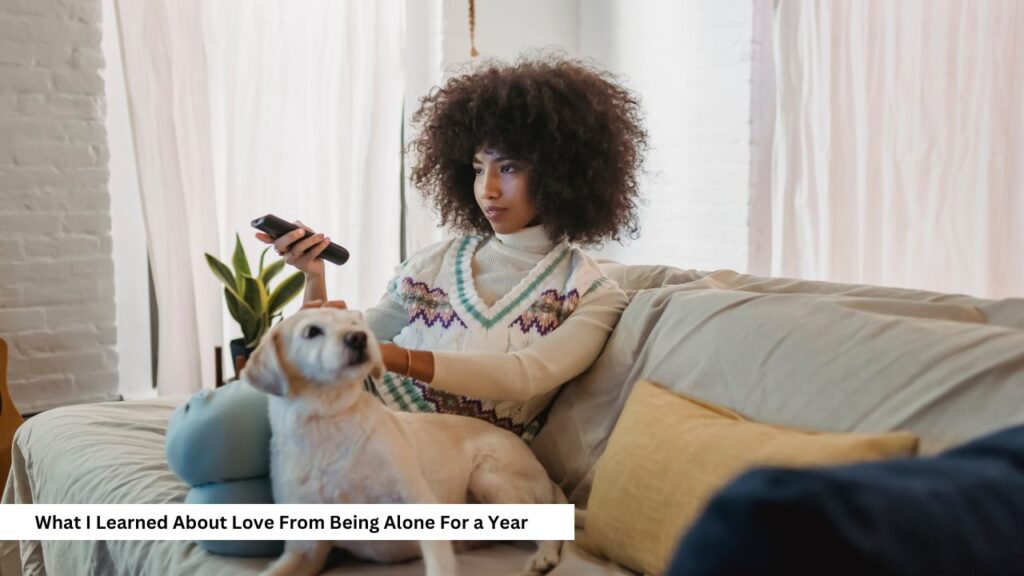
The silence hit me first. Not peaceful silence, uncomfortable silence. The kind that has nowhere to hide. When you’ve been in a long relationship, and then you’re suddenly, completely alone, the quiet is almost physical. You feel it in the evenings. On Sunday mornings. In all the spaces that used to be filled with someone else’s presence, someone else’s energy, someone else’s needs requiring your attention.
At first, I tried to fill it. Netflix, phone scrolling, plans that didn’t need to be made, conversations that didn’t need to happen. Anything to avoid sitting in the stillness.
Then one night, I just stopped. I sat in the quiet, and I let it be quiet. No agenda. No distraction. Just me and the room and whatever was going to come up.
What came up was everything I had been too busy to hear.
I Discovered I Had Been Using Relationships as a Mirror
This was uncomfortable to admit but during that year of being alone with no one else’s feelings to manage, no one else’s reactions to read, no one else’s approval to be aware of. I realised how much of my sense of self had been dependent on being in a relationship.
Not in a romantic way. In a much more fundamental way. I had been using how people responded to me to figure out who I was. If he was happy, things were good. If he was distant, something was wrong — with me, with us, with the whole situation. My internal compass was calibrated to external reactions instead of my own truth.
Being alone stripped that away. With no one else’s feelings to bounce off of, I had to figure out who I actually was on my own terms. What I thought. What I felt. What I believed about myself when no one was around to confirm or contradict it.
That process was disorienting at first. Then it became the most grounding thing I had ever done.
Loneliness and Solitude Are Not the Same Thing
I learned this one slowly. In the beginning, being alone felt like loneliness full stop. The two things were indistinguishable. Being by myself felt like a problem to be solved, a deficit, something to be filled as soon as possible.
As the weeks turned into months, something changed. There started to be evenings where I was alone and completely, genuinely fine. Where I wasn’t lonely, I was just by myself, and by myself felt okay. Good, even. I was reading things I wanted to read. Going places I wanted to go. Spending my time in ways that felt nourishing rather than just ways that kept the silence at bay.
That’s when I understood the difference. Loneliness is the ache of disconnection from others, and often from yourself. Solitude is the practice of being with yourself on purpose. They can feel similar on the surface. The difference is in what’s underneath.
One depletes you. The other, done with some intention, quietly builds you back up.

I Had Been Outsourcing My Happiness Without Realising It
During that year alone, I noticed something. The days when I felt good weren’t random. When things had been warm with someone I cared about, I felt okay. When they hadn’t, I felt unsettled in a way that had nothing to do with what else was happening in my life.
I had been running my emotional well-being through other people without fully realising it. My mood was a product of how my relationships were going rather than something I was actually generating from the inside.
Learning to generate it from the inside, to create my own sense of okay-ness that didn’t depend on anyone else’s behaviour, was some of the most important work I did that year. It didn’t happen overnight. It took practice, but by the end of it, I had built something inside myself that hadn’t been there before. A kind of steadiness. A floor that held regardless of what was happening around me.
I Stopped Being Afraid of My Own Company
This one surprised me more than any of the others because I didn’t know I was afraid of it until I wasn’t anymore.
There’s a particular fear that lives in people who have always been in relationships, always had someone, always filled the space quickly after one ended. It’s the fear that if you’re alone with yourself for long enough, you won’t like what you find. That the quiet will confirm something you’ve been afraid was true.
I had that fear. I didn’t know I had it, but I had it.
What I found in the quiet was not what I was afraid of finding. It was just me. Complicated, imperfect, sometimes messy, but genuinely okay. Worth spending time with. Worth knowing properly. Worth choosing, not out of necessity, but out of actual appreciation.
I became someone I genuinely liked being around. That sounds like a small thing. It was one of the biggest things that year gave me.
What It Changed About How I Love
When I came out of that year, when I eventually opened myself up to being in a relationship again, something was different. Not dramatically, not overnight, but in real and measurable ways.
I stopped needing to be chosen to feel worthy. I stopped interpreting someone’s bad day as information about my value. I stopped shrinking to keep people comfortable. I stopped staying past the point where I’d clearly seen something that I needed to see.
I had spent a year being enough for myself. Just myself, in a quiet room, building a life that was entirely mine. That experience changed the floor of everything. It raised the minimum of what I was willing to accept because I now knew from actual lived experience that my own company was better than the wrong person’s.
That knowledge is not something anyone can give you. You have to build it yourself.
Final Thought On What I Learned About Love From Being Completely Alone For a Year
I am not going to tell you that everyone needs a year alone, because I don’t think that’s true. What I do believe is that most of us need a version of that, some period of deliberate solitude, some time to hear our own voice without anyone else’s noise in the way.
Not to swear off love. Not to become someone who doesn’t need people but to know yourself well enough that when love does show up again, you can receive it from a place of wholeness rather than hunger. From choice rather than fear. From someone who knows her own worth and isn’t asking a relationship to calculate it for her.
That year alone was not the romantic version of a comeback story. It was quiet and sometimes hard and occasionally very boring, but it gave me something I had been looking for in other people for most of my adult life.
It gave me myself. Turns out that was what I needed all along.
Related posts:
The divorced woman glow up, how to rebuild a life that’s better